You Won’t Believe What I Found in Yogyakarta
When I landed in Yogyakarta, I wasn’t expecting much—just another Southeast Asian city with temples and street food. But then I turned a corner and saw a palace made of volcanic rock glowing in the sunset. That moment changed everything. Yogyakarta isn’t just about history; it’s a living gallery of architectural wonders you’ve probably never heard of. From ancient temples fused with Javanese soul to modern buildings shaped like giant lotus flowers, this city surprises at every turn. It doesn’t advertise its beauty through billboards or glossy brochures. Instead, it reveals itself in quiet moments—a shadow across carved stone, the echo of gamelan drifting from a courtyard, the way sunlight filters through a pavilion’s wooden latticework. This is a place where architecture isn’t just built; it’s lived in, breathed, and passed down like a sacred heirloom.
First Impressions: A City That Defies Expectations
Yogyakarta greets travelers with unassuming humility. The airport, modest in scale and design, gives little hint of the cultural richness that lies beyond the terminal. There are no grand monuments in sight, no towering skyline—just the warm tropical air and the faint scent of clove cigarettes and grilled satay. Yet within minutes of leaving the airport, the city begins to reveal its layered identity. What strikes most visitors is the seamless coexistence of old and new: a centuries-old mosque with a golden dome stands just blocks from a minimalist café built from reclaimed teak, while electric scooters weave through alleys where artisans still carve wayang puppets by hand.
For many, especially those familiar with Indonesia’s more internationally known destinations like Bali or Jakarta, Yogyakarta defies expectations. It lacks the beach resorts of the former and the skyscraper density of the latter, but it possesses something deeper—a quiet confidence in its cultural roots. The city, often called “Jogja” by locals, is a self-governing region with a sultan at its head, a rare arrangement in modern Indonesia. This autonomy has allowed Jogja to preserve its architectural identity without succumbing to the generic urbanization seen in other Indonesian cities.
The first true architectural revelation for most visitors comes in the form of the *joglo* roof—a traditional Javanese house style with a towering, multi-tiered peak resembling a mountain. These roofs, once reserved for nobility, now appear in everything from private homes to government buildings and even modern art galleries. The design is not merely aesthetic; it symbolizes the connection between earth and sky, a core concept in Javanese cosmology. Seeing a *joglo* roof atop a contemporary structure—its wooden beams carefully joined without nails—offers a powerful reminder that tradition here is not preserved in museums, but actively reinterpreted.
Prambanan Temple: Where Ancient Engineering Meets Myth
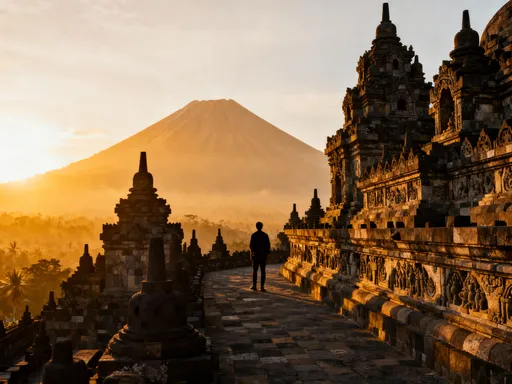
Rising from the flat plains east of Yogyakarta, the Prambanan Temple complex stands as one of Southeast Asia’s most awe-inspiring architectural achievements. Built in the 9th century during the height of the Hindu Mataram Kingdom, this UNESCO World Heritage Site consists of over 200 temples, though the main trio—dedicated to Shiva, Vishnu, and Brahma—dominates the landscape. Each temple soars over 47 meters high, their slender, curving spires (*candis*) reaching skyward like stone flames. At sunrise, when the first light hits the volcanic rock, the entire complex seems to glow from within, as if powered by an ancient energy.
What makes Prambanan extraordinary is not just its scale, but the precision of its craftsmanship. The stone carvings that wrap around each temple tell stories from the Ramayana and Mahabharata, with every figure—from gods to demons to dancing apsaras—etched in astonishing detail. These reliefs are not merely decorative; they serve as a visual scripture, guiding devotees through moral and spiritual lessons. The alignment of the temples also reflects a sophisticated understanding of astronomy and cosmology. The central Shiva temple is positioned to align with Mount Merapi, Java’s most active volcano, symbolizing the axis between the human and divine realms.
Compared to other ancient Southeast Asian sites like Angkor Wat or Bagan, Prambanan stands out for its vertical emphasis and Hindu iconography, which is rare in predominantly Muslim Indonesia. While Angkor Wat evokes a sense of imperial grandeur and Bagan a spiritual vastness, Prambanan feels dynamic, almost theatrical. The temples were not built as tombs or fortresses but as active places of worship, where rituals and dance once brought the carvings to life. Even today, during the full moon, traditional Ramayana ballets are performed in an open-air theater adjacent to the site, linking past and present in a continuous cultural thread.
Visiting Prambanan is not just about seeing ruins; it’s about witnessing the resilience of a civilization. The complex was abandoned for centuries after volcanic eruptions and shifting political power, only to be rediscovered in the 19th century. Restoration efforts have been ongoing, with Indonesian archaeologists using original construction techniques to rebuild collapsed sections. This commitment to authenticity—using interlocking stone without mortar—ensures that the temple remains not just a monument, but a testament to enduring engineering wisdom.
Kraton Yogyakarta: The Sultan’s Palace as Living Heritage
At the heart of Yogyakarta lies the Kraton, the royal palace of the Sultan of Yogyakarta. Unlike many royal residences turned into museums, the Kraton remains a living, functioning institution. The current sultan, Hamengkubuwono X, still resides here, and daily court rituals continue as they have for over 250 years. The palace is not a relic frozen in time, but a vibrant center of Javanese culture, governance, and spirituality. Its architecture reflects this dual role—part fortress, part spiritual sanctuary, part administrative hub.
The Kraton’s design is a masterclass in symbolic planning. Spread across 18 hectares, the complex is laid out in concentric courtyards, each representing a different level of social and spiritual hierarchy. The outermost area is open to the public and houses markets and craft workshops, while the innermost sanctum is reserved for royal family and ceremonies. The main gate, called *Keben*, faces north and is adorned with intricate carvings of mythical creatures like the *naga* (dragon) and *makara* (sea monster), believed to ward off evil spirits. Inside, the *pendhapos*—open-sided pavilions with soaring *joglo* roofs—serve as spaces for meetings, performances, and meditation.
Architecturally, the Kraton is a fusion of Javanese, Islamic, and Dutch colonial influences. The use of red brick and teak wood is distinctly Javanese, while the geometric patterns and calligraphy reflect Islamic artistry. The layout, with its strict symmetry and cardinal orientation, aligns with Javanese cosmology, which sees the palace as the center of the universe. Even the colors have meaning: the red brick symbolizes the earth, while the golden roofs represent divine light. During Dutch colonial rule, European-style windows and iron grilles were added, creating a unique hybrid aesthetic that speaks to Indonesia’s layered history.
For visitors, entering the Kraton requires more than a ticket—it demands respect. Modest dress is expected, and shoes must be removed before stepping onto certain pavilions. These rules are not mere formalities; they reflect the belief that sacred space must be approached with mindfulness. The silence within the inner courtyards, broken only by the occasional chime of a gamelan or the rustle of palm leaves, invites contemplation. Here, architecture is not just about shelter or beauty; it’s about creating an environment where the soul can settle.
Taman Sari Water Castle: A Forgotten Masterpiece
Just west of the Kraton lies Taman Sari, once a royal garden and bathing complex built in the mid-18th century for Sultan Hamengkubuwono I. Today, only about 15 percent of the original structure remains, yet even in ruin, Taman Sari exudes ingenuity and elegance. What was once a sprawling network of pools, fountains, and underground chambers now feels like a dream half-remembered—fragments of beauty emerging from jungle overgrowth. Yet beneath the decay lies a testament to advanced hydraulic engineering, centuries ahead of its time.
The complex was designed as a self-contained paradise, where the sultan and his court could retreat from public life. The main bathing area, known as *Umbul Pasiraman*, features a series of octagonal pools fed by natural springs. Women of the royal harem would bathe here, shielded from view by high walls and screened pavilions. What astonishes modern visitors is the sophistication of the water system: channels and reservoirs regulated flow, while underground tunnels allowed servants to refill pools without being seen. One tunnel even leads to the nearby mosque, enabling the sultan to travel privately for prayer—a feature that blends privacy, piety, and practicality.
Another remarkable element is the *Sumur Gumuling*, a circular multi-level tower that served as a meditation space and possibly an astronomical observatory. Its design includes hidden rooms, ventilation shafts, and a rooftop garden, suggesting a deep understanding of climate-responsive architecture. Though much of Taman Sari was dismantled during the colonial period and later urban development, ongoing restoration projects are slowly bringing its genius back to light. Archaeologists have used old Dutch sketches and Javanese manuscripts to guide reconstruction, ensuring historical accuracy.
Exploring Taman Sari can be done independently, but a knowledgeable guide enhances the experience significantly. Without context, the ruins may seem like scattered stone and algae-covered pools. With a guide, they transform into a narrative of royal life, spiritual practice, and technological innovation. Even solo visitors can appreciate the play of light and shadow, the coolness of the underground chambers, and the quiet beauty of lotus blossoms floating on still water. Taman Sari reminds us that architecture is not always about permanence—it’s about memory, and the traces left behind.
Modern Marvels: How Yogyakarta Builds Its Future
While Yogyakarta honors its past, it is far from stagnant. The city’s architectural evolution continues, with new buildings that pay homage to tradition while embracing modern needs. One striking example is the new terminal of Yogyakarta International Airport, located south of the city. Its sweeping roof, inspired by the *joglo* and the wings of a *garuda* (mythical bird), creates a grand yet welcoming entrance. The use of natural light, cross-ventilation, and local stone reduces energy consumption, making it a model of sustainable design.
Across the city, architects are reimagining urban spaces with cultural sensitivity. New university buildings at Gadjah Mada University incorporate open-air classrooms and courtyards, fostering community interaction while staying cool in the tropical heat. Art schools like ISI (Indonesian Institute of the Arts) feature experimental structures—some made from bamboo, others with green roofs—that challenge conventional materials and forms. These buildings are not just functional; they are statements of identity, asserting that modernity need not erase heritage.
A growing trend is the use of local materials—teak, volcanic stone, *alang-alang* grass roofs—in both private homes and public buildings. These materials are not only sustainable but also culturally resonant. A modern café in the Prawirotaman district, for instance, might feature a *joglo* roof supported by reclaimed teak beams, with walls made of permeable *batako* (concrete brick) to allow airflow. Such designs reduce reliance on air conditioning and create spaces that feel grounded, not generic.
Public spaces, too, are being rethought. Parks like Alun-Alun Kidul are no longer just green patches but active social hubs, where families gather at night, children fly kites, and street vendors sell *gudeg* and *wedang ronde*. Benches are arranged to encourage conversation, and lighting is soft and warm, creating an atmosphere of safety and inclusion. In a world where urban design often prioritizes efficiency over emotion, Yogyakarta chooses connection.
Off-the-Beaten-Path Gems Only Locals Know
Beyond the famous sites, Yogyakarta’s true architectural soul lies in its neighborhoods—*kampungs* where tradition thrives in everyday life. In areas like Kotabaru or Patehan, narrow alleys open into hidden courtyards where families live in traditional *omah Jawa* (Javanese houses). These homes, often centuries old, feature carved wooden doors, central atriums, and *joglo* roofs, yet are adapted for modern living. A grandmother might brew coffee on a wood stove while her granddaughter videos a TikTok dance in the same room—proof that heritage is not preserved in isolation, but lived.
Community-led initiatives are playing a crucial role in preserving these spaces. In the Tembi village, residents have restored old houses into cultural centers and homestays, offering visitors an intimate look at Javanese life. One such project, Rumah Kreatif Tembi, began as a derelict warehouse and was transformed into a gallery, workshop space, and café using recycled materials. The building’s exposed brick walls and high ceilings allow for natural light and airflow, while its open layout invites collaboration and creativity.
Walking tours, increasingly popular among culturally curious travelers, offer a deeper understanding of these hidden gems. Led by local residents, these tours take visitors through backstreets where batik is still hand-dyed, where blacksmiths shape ceremonial *kris* daggers, and where neighbors gather under *pendhapos* to discuss the day’s news. Unlike curated tourist routes, these experiences feel authentic, unscripted, and deeply human.
Another emerging trend is the rise of eco-homes and adaptive reuse projects. Architects are converting old colonial offices into boutique hotels, turning abandoned factories into artist studios, and designing low-impact homes that blend into the landscape. These efforts reflect a growing awareness that sustainability is not just environmental, but cultural—preserving identity in the face of rapid change.
Why Architecture in Yogyakarta Matters Beyond Beauty
The architecture of Yogyakarta is not merely about aesthetics or historical preservation; it is a reflection of a worldview. In Javanese culture, design is inseparable from spirituality, community, and harmony with nature. Every structure, from a thousand-year-old temple to a modest family home, is built with intention—considering orientation, material, proportion, and symbolism. This holistic approach offers valuable lessons for cities worldwide grappling with soulless urbanization and environmental degradation.
Traditional Javanese building methods, for example, are inherently sustainable. The use of natural ventilation, thermal mass materials like stone and brick, and passive cooling techniques reduces energy consumption without sacrificing comfort. The *joglo* roof, with its high peak, allows hot air to rise and escape, keeping interiors cool. These principles are now being studied by architects seeking climate-responsive solutions in tropical regions.
Moreover, Yogyakarta’s resistance to generic development models is a quiet act of cultural preservation. While many cities replace old neighborhoods with glass towers and shopping malls, Jogja has chosen a different path—one of integration and respect. New buildings do not overshadow the old; they converse with them. This balance between progress and tradition creates a city that feels cohesive, not fragmented.
For travelers, this means an opportunity to practice slow travel—to move beyond checklists and truly see. Walking through Yogyakarta is like reading a book written in stone, wood, and shadow. Each structure tells a story: of kings and commoners, of faith and innovation, of continuity and change. To visit Yogyakarta is not just to see architecture, but to feel it—to understand that buildings are not just shelters, but vessels of memory, meaning, and human intention.
Yogyakarta doesn’t shout its brilliance—it reveals it slowly, through shadow and stone, curve and silence. Its architecture isn’t just about style; it’s a language spoken across centuries. Whether standing before a thousand-year-old temple or a quietly innovative café in a restored warehouse, you feel the presence of intention, of memory. This city teaches us to look closer, to move slower, and to understand that every wall tells a story. If you’re searching for places where form meets soul, start here.